What Is a Short Sale? A Plain-English Guide
Updated: 2 days ago
What is a short sale?
A short sale is the sale of a home for less than the total amount owed on its mortgage and other claims against the property. Because the sale proceeds will not fully repay what is owed, the mortgage servicer and any other parties with approval rights must agree before the transaction can close. A short sale may help some homeowners avoid foreclosure, but it is not automatic, fast, or guaranteed. The homeowner must still sell and leave the property, submit financial information, and review the approval terms carefully before deciding whether to proceed.
Why is it called a short sale?
The word “short” refers to the money coming up short, not necessarily to the timeline. If a home sells for $250,000 but the mortgage payoff, liens, taxes, closing costs, and approved expenses total more than the available proceeds, there is a shortage. The parties entitled to that money must decide whether they will accept less than the full amount due.
The Consumer Financial Protection Bureau, or CFPB, describes a short sale as a type of loss mitigation in which a home is sold for less than the amount owed on the mortgage. It is an alternative to foreclosure, but it is still a sale, so the homeowner must leave the home.
Who must approve a short sale?
The homeowner accepts the buyer’s offer, but that acceptance alone is not enough. The mortgage servicer usually reviews the short-sale request on behalf of the loan owner or investor. Depending on the loan and property, approval may also be required from:
The owner or investor behind the first mortgage
A second-mortgage lender or home equity line of credit holder
A mortgage insurer
A homeowners association or other lienholder
A government agency or guarantor connected to the loan
Each approving party may have its own documents, valuation, deadlines, and conditions. That is why a short-sale approval should be read as a set of terms, not as a simple yes. The approval may address the permitted sale price, closing costs, commissions, closing deadline, relocation assistance, cash contribution, promissory note, and treatment of any remaining balance.
Who is involved in a typical short sale?
A short sale usually involves more people than a standard home sale. The exact group varies, but common participants include:
The homeowner or homeowners
The buyer
The listing real estate professional and the buyer’s real estate professional
The mortgage servicer and the loan owner or investor
Any junior lienholders, mortgage insurers, associations, or other claimants
A title or settlement company
A short-sale negotiator or mitigation specialist, when permitted and appropriate
A HUD-approved housing counselor, attorney, tax professional, or financial adviser
No single participant can promise the outcome. A qualified professional can organize documents, communicate with the parties, and help the homeowner understand the process, but approval authority remains with the parties whose money or legal rights are affected.
How does the short-sale process work?
The process differs by servicer and loan type, but it generally follows these steps:
1. Review the homeowner’s situation. Confirm estimated property value, mortgage balances, liens, sale costs, hardship, foreclosure status, and alternatives.
2. Contact the mortgage servicer. Ask which loss-mitigation options are available and what documents are required for a short-sale review.
3. Prepare the package. The servicer may request financial statements, income and expense records, a hardship explanation, mortgage information, property documents, and authorization forms.
4. Market the home and obtain an offer. Some servicers review a short sale before an offer exists, while others require a signed purchase agreement first.
5. Submit the offer and supporting documents. The servicer may order a valuation, review the buyer and transaction, and request updates or additional information.
6. Resolve other claims. Junior mortgages and other lienholders may need to agree to the amount they will receive and to release their claim against the property.
7. Review the written approval. The homeowner should examine every condition, especially the closing deadline and any language about a remaining balance, waiver, contribution, or promissory note.
8. Close only if all required approvals are in place. Approval can expire or change if the price, buyer, costs, or timing changes.
Short sales can take longer than ordinary sales because several parties may be reviewing the same transaction. A complete package and prompt responses can help, but nobody can guarantee a particular approval or closing date.
What decision should a homeowner make first?
The first decision is not “Should I list the house?” It is “Should I explore keeping the home, selling it, or leaving it through another option?” A practical decision path looks like this:
1. Do you want to keep the home, and can the payment become affordable? Ask the servicer about available loss-mitigation options, which may include a repayment plan, forbearance, or loan modification depending on the circumstances.
2. If keeping the home is not workable, would a normal sale pay all mortgages, liens, and selling costs? Get a realistic value and a current payoff and title review.
3. If the proceeds are likely to fall short, is a short sale available and preferable to other options? Compare it with foreclosure, a deed in lieu of foreclosure, bankruptcy advice when relevant, and any other option offered by the servicer.
4. Before accepting short-sale terms, what happens to the unpaid balance? Do not assume it disappears. Ask for the answer in writing and have the documents reviewed by an appropriate professional.
5. What are the tax, credit, housing, and timing consequences? These can vary by individual facts and applicable law, so personalized legal and tax advice matters.
What happens to the unpaid mortgage balance?
The gap between what is owed and what the lender receives is often called a deficiency. A short sale does not automatically erase that amount. The CFPB advises homeowners to ask the lender to waive the deficiency before proceeding when the homeowner could otherwise remain responsible, and to obtain any waiver in writing.
The result depends on the approval terms, loan documents, applicable law, and the parties involved. A homeowner should not rely on a verbal statement that the debt is “handled.” The closing paperwork should clearly explain whether the remaining balance is waived, preserved, settled, or addressed through another obligation.
How can a short sale affect credit and taxes?
A short sale and any missed mortgage payments may affect credit, future borrowing, and the ability to obtain another mortgage. The impact is not identical for every homeowner because credit histories, reporting, loan programs, and timing differ.
A forgiven or canceled debt may also have tax consequences. Federal tax rules can change, and individual circumstances matter. Homeowners should ask a qualified tax professional to review the current rules and any tax forms connected to the transaction. A real estate professional or negotiator should not promise a specific credit score or tax result.
How is a short sale different from foreclosure?
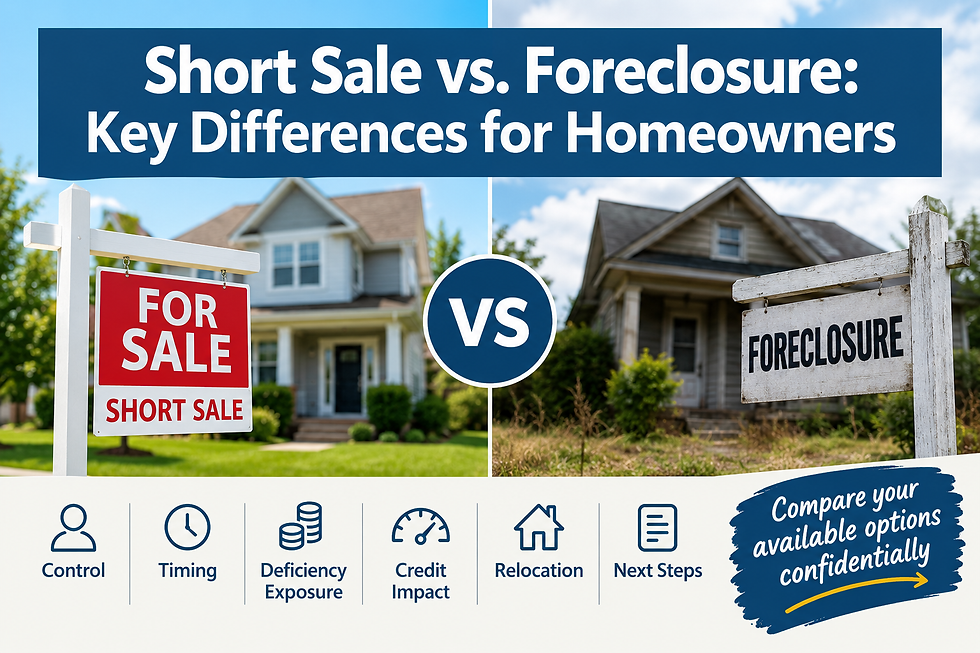
In a short sale, the homeowner sells the property with the required approvals before the lender completes a foreclosure. In a foreclosure, the lender uses a legal process to take or sell the property after default. Both can have serious financial and credit consequences. A short sale may give the homeowner more involvement in the sale and moving timeline, but it still requires cooperation, documentation, a qualified buyer, and written approval.
Foreclosure timelines and homeowner rights are governed by applicable law and loan rules. If a foreclosure is pending, do not assume that applying for or negotiating a short sale automatically stops it. Confirm deadlines directly with the servicer and obtain legal advice when needed.
Warning signs of a short-sale scam
Homeowners under pressure are common targets for scams. Be cautious if someone:
Guarantees approval or promises to stop a foreclosure
Tells you to stop communicating with your mortgage servicer
Demands that you sign ownership over to another person
Pressures you to sign documents you do not understand
Asks you to hide payments, relationships, or transaction terms
Requests prohibited upfront fees or gives unclear fee disclosures
The CFPB warns that foreclosure-relief scams may use official-looking names, demand money, or tell homeowners to send mortgage payments somewhere new. Verify who you are dealing with and keep written records.
Frequently asked questions about short sales
1. Can I do a short sale if I am current on my mortgage?
Possibly. Eligibility is determined under the applicable servicer, investor, insurer, or program rules and the homeowner’s circumstances. Being current or delinquent does not create an automatic approval.
2. Do I need a buyer before requesting approval?
It depends on the servicer and program. Some reviews can begin before an offer is received. Others require a signed purchase agreement and transaction documents.
3. How long does a short sale take?
There is no universal timeline. The number of loans and liens, document completeness, property valuation, buyer changes, and response times can all affect the process.
4. Can the lender reject the buyer’s offer?
Yes. The parties with approval rights may reject the price or terms, request changes, order another valuation, or decline the short sale.
5. Will I owe money after a short sale?
You might. The written approval should state how any deficiency or remaining balance will be treated. Ask whether it will be waived and get any waiver in writing. Legal and tax advice may be appropriate.
6. Can I receive money at closing?
Some programs may permit approved relocation assistance or other payments. Any payment must be fully disclosed and allowed by every required approving party. Never accept an undisclosed side payment.
7. Is a short sale guaranteed to stop foreclosure?
No. A pending review or approved sale should not be assumed to pause every foreclosure action. Confirm the status, deadlines, and requirements with the mortgage servicer and seek legal help if a deadline is close.
Request a confidential short-sale review
If your mortgage balance may be higher than the amount your home can sell for, you do not have to guess your way through the next step. Request a confidential short-sale review from The Owner’s Leaf. We will help you understand the basic process, identify the information that may be needed, and discuss possible next steps. A review does not guarantee eligibility, approval, debt forgiveness, or a completed sale.

About The Owners Leaf Team
The Owners Leaf is a short sale mitigation company that helps homeowners nationwide who owe more than their home is worth. Our team is led by Jason Lash (CEO & Founder, co-host of the Real Estate Minute on WOOD Radio), Heather Garvin (President & Founder), and Jhamie BV (Lead Negotiator), who works directly with lenders on short sale approvals.
Meet the team, get free help with your situation, or call 616-821-1350.

Comments