Can I Do a Short Sale After Losing My Job?
Losing your job can make it difficult or impossible to keep up with a mortgage payment. Job loss can be a hardship considered during a mortgage loss-mitigation review, and a short sale may be one option depending on your financial situation, the value of your home, your loan, and your mortgage servicer's requirements. A short sale generally means selling your home for less than the amount owed on the mortgage, with the servicer's approval required.
If you have recently lost your job, the most important steps are to document the income loss, prepare a clear hardship explanation, gather financial records, understand your available income—including unemployment benefits—and contact your mortgage servicer promptly.
Can Job Loss Qualify as a Hardship?
Yes, job loss can qualify as a financial hardship for mortgage assistance purposes.
The Consumer Financial Protection Bureau (CFPB) identifies unemployment as an example of a hardship that can significantly reduce a borrower's income or affect the ability to make mortgage payments. A loss-mitigation application generally requires borrowers to explain the change in their financial circumstances and provide supporting evidence.
However, experiencing a hardship does not automatically mean you will qualify for a short sale. The mortgage servicer and, where applicable, the owner or investor of the loan will review the complete circumstances and determine which loss-mitigation options may be available.
Those options could include a loan modification, repayment plan, forbearance, short sale, or deed-in-lieu of foreclosure.
How Job Loss Can Affect Your Short Sale Situation
A job loss can change your financial picture quickly.
Before losing employment, you may have had enough income to cover:
Principal and interest
Property taxes
Homeowners insurance
HOA or condominium expenses
Utilities
Other household expenses
After losing your job, your available monthly income may drop substantially.
Your mortgage servicer will generally want to understand why you are having difficulty making the payment, whether the hardship is temporary or ongoing, and what your current income, expenses, and assets look like.
That makes accurate documentation especially important when pursuing a short sale after job loss.
What Should Be Included in a Hardship Letter?
A hardship letter gives you an opportunity to explain what happened in straightforward terms.
For a job-loss situation, consider addressing:
1. When You Lost Your Job
State the approximate date your employment ended and whether the separation was voluntary or involuntary, if relevant.
2. How Your Income Changed
Explain how your household income changed after the loss of employment.
For example, you might explain that your regular wages ended and that you are currently relying on unemployment benefits, savings, temporary work, or another source of income.
3. Why the Mortgage Is No Longer Affordable
Connect the income loss to the mortgage payment and your overall financial obligations.
Keep the explanation factual rather than emotional.
4. What You Have Done to Address the Situation
You can mention efforts such as:
Applying for unemployment benefits
Searching for new employment
Reducing expenses
Contacting your mortgage servicer
Exploring available mortgage assistance
Reviewing whether selling the property is financially realistic
5. What You Are Requesting
If a short sale is being considered, clearly state that you want to discuss whether the property may qualify for short-sale review.
A hardship letter should be supported by documentation whenever possible. CFPB guidance notes that servicers may require a hardship explanation and evidence supporting the hardship.
What Documents Should I Prepare After Losing My Job?
Requirements vary by loan and servicer, but preparing your financial records early can make the process more organized.
A short sale after job loss checklist may include:
Recent mortgage statements
Recent bank statements
Recent pay stubs, if you have any remaining employment income
Termination or separation documentation, when available
Unemployment benefit documentation
Severance documentation, if applicable
Tax returns or other income documentation requested by the servicer
Monthly expense information
Information about other debts
Information about other assets
A hardship letter
Property information
Any existing foreclosure or mortgage-servicing correspondence
Documents requested in the servicer's loss-mitigation application
The CFPB notes that mortgage assistance applications can require documentation such as pay stubs, bank statements, and other formal records showing income or benefits.
Do not assume that one checklist applies to every mortgage. Ask your servicer for the specific documents required for your situation.
Do Unemployment Benefits Affect a Short Sale Review?
Unemployment benefits are important to disclose when discussing your current financial situation with your mortgage servicer.
The way unemployment income is treated can depend on the loan program, investor requirements, and the particular loss-mitigation review. For example, Fannie Mae's servicing guidance states that unemployment insurance benefits are not included as monthly gross income for its short-sale eligibility calculation.
That does not mean unemployment benefits are irrelevant to your situation. They can still help document your current circumstances and available resources.
The safest approach is to provide accurate documentation and ask your servicer how those benefits will be treated under your specific loan.
Should I Wait Until I Miss a Mortgage Payment?
Not necessarily.
If you already know that losing your job will make your mortgage payment difficult, contacting your servicer early can give you more time to understand your options.
The CFPB recommends contacting the mortgage servicer as soon as you know you may have difficulty making your payment. HUD similarly advises homeowners experiencing financial problems to contact their lender promptly rather than ignoring the situation.
Depending on your circumstances, a short sale may not be the only option.
For example, temporary financial hardship may make forbearance worth discussing. A permanent reduction in income may require a broader review of available loss-mitigation or home-disposition options.
How Does Timing Matter After Job Loss?
Timing matters because mortgage problems can become more difficult to manage as delinquency progresses.
If you have received notices from your mortgage servicer, respond to them and ask what loss-mitigation options are available.
Federal mortgage-servicing rules also establish important timing requirements around loss-mitigation applications and foreclosure processes. For example, the CFPB explains that, in most cases, foreclosure cannot begin until a borrower has been delinquent for at least 120 days, while other deadlines can apply depending on the stage of the process.
Do not rely on a general timeline for your individual situation. Your loan documents, servicer, foreclosure status, and applicable laws can affect the process.
What Happens During a Short Sale Review?
A short sale generally involves several stages:
Identify the financial hardship.
You document the job loss and its effect on your ability to maintain the mortgage.
Contact the mortgage servicer.
Ask about loss-mitigation options and whether a short sale may be considered.
Complete the required application.
The servicer may provide a specific loss-mitigation or short-sale package.
Submit financial documentation.
This may include income, expenses, assets, bank statements, hardship documentation, and other requested information.
Evaluate the property and potential sale.
A short sale generally involves selling the property for less than the mortgage balance.
Submit an offer if appropriate.
The servicer must approve the transaction before the short sale can proceed.
Review the approval terms carefully.
Pay attention to whether the remaining balance or deficiency is waived and to any tax or other financial consequences.
The CFPB explains that a short sale requires servicer approval and that homeowners should understand the specific terms, including potential deficiency and tax implications.
What If My Home Is Worth Less Than I Owe?
This is one of the circumstances in which a short sale may become relevant.
A short sale occurs when a home is sold for less than the amount owed on the mortgage, with the lender or servicer agreeing to accept the proceeds under the applicable approval process.
But negative equity alone does not automatically mean a short sale will be approved.
The servicer may review factors such as:
Your financial hardship
Your current income
Your expenses
Your assets
The property's value
The amount owed
The proposed sale
The loan's requirements
Applicable investor guidelines
For this reason, a homeowner dealing with job loss should look at the entire financial picture, rather than assuming that unemployment or negative equity by itself determines the outcome.
What Should I Do Now?
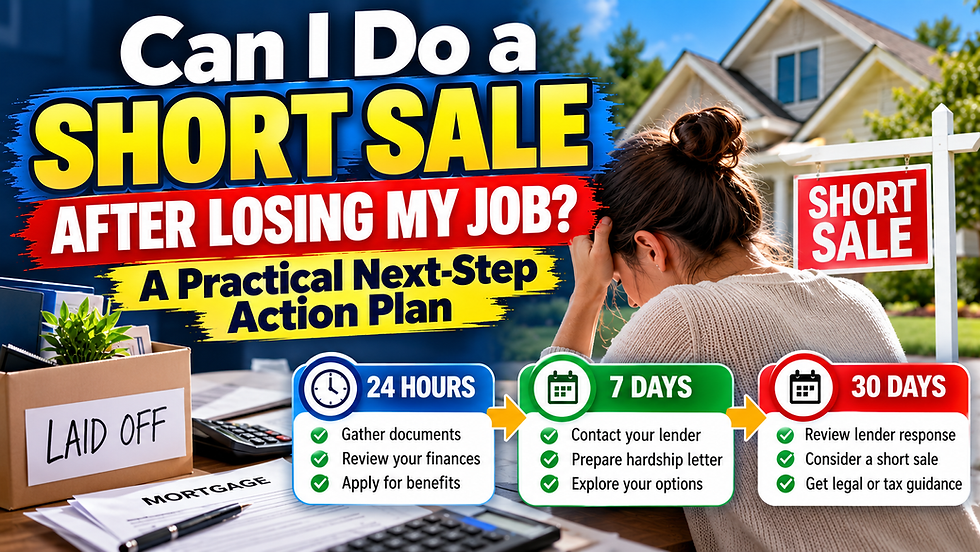
If you recently lost your job and are concerned about your mortgage, consider this simple action plan:
Today
Review your mortgage statement.
Identify your mortgage servicer.
Estimate your current monthly income.
List essential monthly expenses.
Gather employment-loss documentation.
Check your unemployment-benefit status.
Contact your servicer before ignoring the problem.
Within the Next Few Days
Ask about loss-mitigation options.
Request the appropriate application or short-sale information.
Prepare your hardship letter.
Gather bank statements and other requested records.
Determine whether you have positive or negative equity.
Ask about deadlines that apply to your loan.
Before Signing Anything
Ask questions about:
The short-sale approval process
The amount needed to satisfy the mortgage
Whether any deficiency will remain
How additional liens will be handled
Potential tax consequences
Relocation assistance, if available
What happens if the property does not sell
Whether you should consult a housing counselor or attorney
A HUD-approved housing counselor can help homeowners understand available options and work through the mortgage-assistance process. CFPB also provides resources for finding housing counseling assistance.
Frequently Asked Questions About a Short Sale After Job Loss
1. Can job loss qualify as a hardship?
Yes. Unemployment is recognized by the CFPB as an example of a financial hardship that can significantly reduce income and affect the ability to make mortgage payments. Qualification for a particular loss-mitigation option, however, depends on the circumstances and applicable requirements.
2. Can I request a short sale if I am receiving unemployment benefits?
You can discuss a short sale with your mortgage servicer while receiving unemployment benefits. How those benefits are treated in the review depends on the applicable loan and investor requirements. For example, Fannie Mae's published servicing guidance says unemployment insurance benefits are not included as monthly gross income in its short-sale eligibility calculation.
3. Do I need to be behind on my mortgage to discuss a short sale?
You should not assume that you need to wait until you miss payments before contacting your servicer. The CFPB recommends contacting your servicer as soon as you know you may have trouble making payments. Your servicer can explain which options and
requirements apply to your loan.
4. What should I include in my hardship letter after losing my job?
Explain when and how your employment ended, how your income changed, why the mortgage has become difficult to maintain, what steps you have taken, and what assistance you are requesting. Support the explanation with appropriate documentation.
5. Does losing my job automatically qualify me for a short sale?
No. Job loss may establish a hardship, but it does not automatically qualify someone for a short sale. The servicer may evaluate the borrower's financial circumstances, property value, loan balance, proposed sale, and applicable program or investor requirements.
6. Is a short sale better than foreclosure?
The answer depends on the homeowner's circumstances and the terms available. A short sale is one possible alternative to foreclosure, but it has its own requirements and financial consequences. Homeowners should compare the available options with their servicer and, when appropriate, a HUD-approved housing counselor or qualified attorney.
7. Who can help me understand my options after job loss?
Start with your mortgage servicer and consider contacting a HUD-approved housing counseling agency. HUD-approved counselors can help homeowners understand mortgage-assistance and foreclosure-avoidance options.
Final Takeaway: A Short Sale After Job Loss Starts With Understanding Your Options
Losing your job can create a significant change in your ability to afford your mortgage. Job loss can be considered a financial hardship, but it does not automatically result in short-sale approval.
The most useful first steps are to document the income loss, prepare a clear hardship letter, gather your financial records, understand how current benefits are treated, and contact your mortgage servicer promptly.
A short sale may be one option among several. Your specific loan, financial circumstances, property value, and servicer requirements will determine what options are available.
Talk Through Your Hardship and Timeline
Talk through your hardship and timeline before assuming you have to wait for foreclosure or that a short sale is automatically the answer. Understanding your situation early can help you identify the questions to ask and the documentation to prepare.
This article is for general educational purposes and is not legal, tax, financial, or mortgage-servicing advice. Short-sale requirements and consequences can vary based on the loan, investor, servicer, property, and applicable law. Consider speaking with your mortgage servicer, a HUD-approved housing counselor, and appropriate legal or tax professionals for advice about your circumstances.


Comments