Can I Do a Short Sale After Losing My Job: A Practical Next-Step Action Plan
Losing your job can quickly turn a manageable mortgage payment into a financial problem. What should a homeowner do next? Start by documenting the income loss, reviewing your immediate budget, applying for unemployment benefits if eligible, and contacting your mortgage servicer as soon as you know you may have trouble making payments. A short sale may be one possible loss-mitigation option, but it is not automatic. Your lender or mortgage servicer will review your circumstances and determine which options may be available. The CFPB recommends contacting your servicer promptly and considering free assistance from a HUD-approved housing counselor.
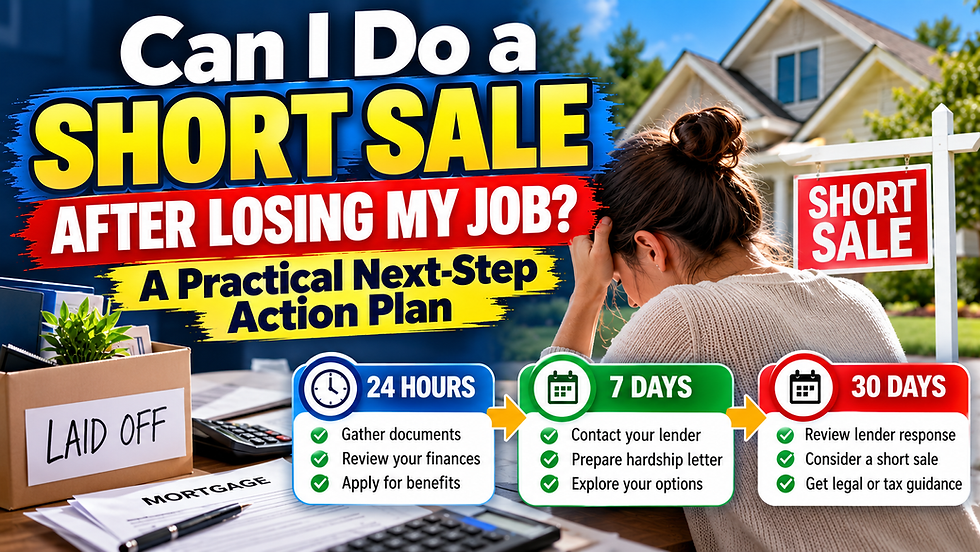
If you are searching for short sale after job loss next steps, the most important thing is to avoid waiting until the situation becomes urgent. Use this 24-hour, 7-day, and 30-day plan to organize your next moves.
What Should a Homeowner Do Next After Losing a Job?
The first priority is to understand your current financial position and communicate with your mortgage servicer.
Your immediate action plan is:
Document your job loss and income reduction.
Apply for unemployment benefits if you may be eligible.
Review your mortgage, savings, debts, and essential expenses.
Contact your mortgage servicer about available loss-mitigation options.
Prepare the financial documents the servicer requests.
Determine whether a short sale is worth exploring alongside other options.
Get professional guidance when legal or tax questions arise.
A short sale is generally a sale of a property for less than the amount owed on the mortgage, with the lender or servicer's approval. It is one type of loss mitigation, but other options may also be available.
Your First 24 Hours: Stabilize Your Financial Situation
The first day after a job loss can feel overwhelming. You do not need to solve every housing decision immediately. Start by collecting information.
1. Confirm Your Current Income
Write down every source of income you currently have, including:
Remaining wages
Severance, if applicable
Unemployment benefits, if applicable
Other reliable income
Available savings
Then compare your current income with your mortgage payment and essential monthly expenses.
The goal is to understand the size of the income gap rather than guessing about what you can afford.
2. Apply for Unemployment Benefits If Eligible
Unemployment insurance is administered through individual states under a joint federal-state program. Eligibility requirements vary, so homeowners should check the unemployment program for the state where they worked. The U.S. Department of Labor recommends filing a claim with the appropriate state unemployment insurance program.
Do not assume that unemployment benefits will cover your mortgage. Instead, consider them one part of your temporary financial picture.
3. Review Your Mortgage Statement
Find your most recent mortgage statement and identify:
Current loan balance
Monthly payment
Principal and interest
Escrow amount
Servicer's contact information
Any past-due amount
Important notices or deadlines
Having these details available will make your conversation with the mortgage servicer more productive.
4. Create a Bare-Bones Budget
Separate expenses into three categories:
Essential:Mortgage, utilities, food, transportation, insurance, and other necessary expenses.
Important but adjustable:Subscriptions, discretionary spending, entertainment, and other expenses that may be reduced temporarily.
Debts and obligations:Credit cards, personal loans, medical bills, and other payments.
This gives you a clearer picture of whether the income loss appears temporary or whether maintaining the mortgage may become difficult over a longer period.
Your First 7 Days: Contact Your Mortgage Servicer
Once you have your basic financial information together, your next priority is communication.
The CFPB recommends contacting your mortgage servicer as soon as you know you may have difficulty making your payment. You should be prepared to explain why you cannot make the payment, whether the problem may be temporary or permanent, and information about your income, expenses, and assets.
Ask About All Available Loss-Mitigation Options
Do not approach the conversation assuming that a short sale is your only option.
Depending on your circumstances and loan, your servicer may discuss options such as:
Forbearance
Repayment plans
Loan modification
Refinancing, when available
Short sale
Deed-in-lieu of foreclosure
The CFPB identifies short sales and deed-in-lieu transactions among potential options for homeowners experiencing mortgage payment problems.
Ask the servicer:
"I recently lost my job and my income has changed. What loss-mitigation options are available based on my current circumstances?"
Then ask what documents are required and whether there are deadlines for submitting an application.
Prepare Your Hardship Documentation
A job loss may affect your ability to make your mortgage payment, but the servicer will need information about your specific financial circumstances.
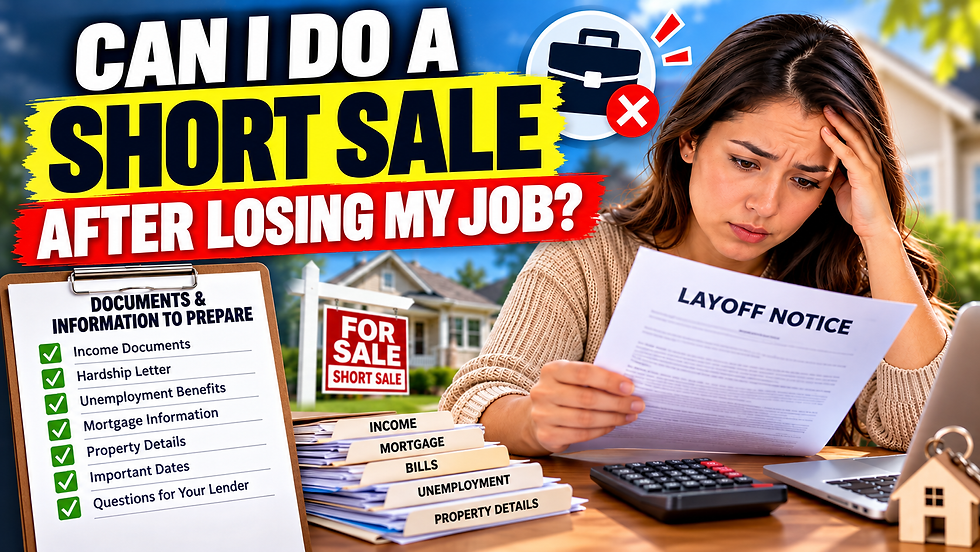
Create a folder containing:
Employment termination or layoff documentation
Recent pay stubs
Mortgage statements
Bank statements
Tax returns, if requested
Unemployment documentation
Information about other income
Monthly expense information
Information about debts
Property information
Insurance information
Information about other liens
A hardship letter, if requested
Keep copies of everything you submit.
What Should a Hardship Letter Explain?
If your servicer requests a hardship letter, keep it factual and straightforward.
Explain:
When you lost your job
How your income changed
How the change affects your mortgage payment
Whether you are looking for new employment
Your current financial circumstances
Why you are requesting mortgage assistance
What you are asking the servicer to review
Avoid exaggerating your situation or making promises about future income that you cannot support.
Your First 30 Days: Determine Whether a Short Sale Fits
By the first month, you should have a clearer understanding of your income, expenses, mortgage situation, and available assistance.
This is the point where you can begin asking whether a short sale should be part of your broader housing strategy.
Understand What a Short Sale Actually Means
A short sale involves selling the property for less than the amount owed on the mortgage, subject to approval from the lender or servicer. The CFPB describes it as a type of loss mitigation and notes that homeowners should understand what happens to any potential deficiency before proceeding.
For example, if a mortgage balance is $300,000 and an approved sale produces $250,000 in proceeds, there is a $50,000 difference before considering other transaction costs and adjustments.
That example does not mean the homeowner automatically owes $50,000 after the sale. The outcome depends on the loan, approval terms, applicable law, and whether the lender agrees to waive any remaining obligation.
Before agreeing to a short sale, ask:
Will the lender approve the proposed sale?
What happens to the remaining mortgage balance?
Will any deficiency be waived?
Will the waiver be provided in writing?
Are there other liens on the property?
What costs must be paid at closing?
What happens if the short sale is not approved?
What obligations remain after closing?
The CFPB recommends asking about deficiency responsibility and obtaining a waiver in writing when applicable.
Should You Wait Until You Miss a Payment?
You do not necessarily need to wait until you are seriously behind before contacting your servicer.
The CFPB advises homeowners who cannot pay their mortgage or are worried about missing a payment to contact their mortgage servicer right away.
That does not mean you should intentionally stop making payments.
Instead, communicate early and ask what options may be available based on your circumstances.
If you receive foreclosure-related legal documents or are facing an imminent foreclosure situation, consider speaking with an attorney promptly. The CFPB also recommends seeking HUD-approved housing counseling for help understanding mortgage options.
When Should You Talk to a HUD-Approved Housing Counselor?
A HUD-approved housing counselor can help you understand your mortgage situation, evaluate potential options, organize documents, and communicate with your mortgage company.
The CFPB states that HUD-approved housing counseling agencies provide foreclosure-prevention counseling at no cost and can help homeowners understand available options.
This can be particularly useful when you are unsure whether to pursue:
A short sale
A loan modification
Forbearance
A repayment plan
A deed-in-lieu
Another loss-mitigation option
A counselor does not guarantee that a particular option will be approved. Instead, the counselor can help you understand the choices available for your situation.
When Should You Talk to an Attorney or Tax Professional?
Some short-sale questions are legal or tax questions rather than real-estate questions.
Talk to an Attorney When You Need Help With:
Potential deficiency liability
Multiple mortgages or liens
Foreclosure legal documents
Contract language
Bankruptcy considerations
Collection activity
Your legal rights and obligations
Talk to a Tax Professional About:
Potential canceled-debt income
Tax reporting
The tax treatment of the sale
Whether a specific tax exclusion or exception may apply
The IRS states that canceled or forgiven debt is generally taxable unless an exception or exclusion applies. The tax treatment depends on the circumstances, so homeowners should not assume that mortgage debt forgiven through a short sale is automatically tax-free.
7 Common Questions About Short Sale After Job Loss Next Steps
1. Can losing my job qualify as a hardship?
It can. Job loss can create a financial hardship that affects your ability to make mortgage payments. However, hardship does not automatically mean a homeowner qualifies for a short sale. The servicer will review the homeowner's individual circumstances and available loss-mitigation options.
2. Should I contact my mortgage servicer immediately?
Yes. If you believe your income loss may make it difficult to make your mortgage payment, contacting the servicer promptly can help you understand available options before the situation becomes more serious.
3. Should I apply for unemployment benefits?
If you may be eligible, yes. Unemployment insurance eligibility is determined under the applicable state program. The Department of Labor recommends filing with the unemployment insurance program in the state where you worked.
4. What documents should I prepare?
Start with employment-loss documentation, mortgage statements, bank statements, income information, expense information, and any documents your servicer specifically requests.
5. Is a short sale my only option after job loss?
No. A short sale is one potential loss-mitigation option. Depending on your circumstances, your servicer may also discuss options such as forbearance, repayment plans, loan modification, or other alternatives.
6. Can I still consider a short sale if I have not missed a payment?
You can ask your servicer whether a short sale or another loss-mitigation option may be considered based on your circumstances. Eligibility and approval depend on the loan and servicer's requirements.
7. What happens to the remaining mortgage balance?
It depends on the transaction and approval terms. Before proceeding, ask specifically whether the lender will waive any remaining deficiency and obtain any waiver or agreement in writing.
Short Sale After Job Loss: Your 24-Hour, 7-Day, and 30-Day Checklist
Within 24 Hours
☐ Document your job loss
☐ Calculate your current income
☐ Check potential unemployment benefits
☐ Review your mortgage statement
☐ List essential monthly expenses
☐ Review available savings
☐ Gather important financial documents
Within 7 Days
☐ Contact your mortgage servicer
☐ Ask about loss-mitigation options
☐ Ask whether a short sale can be considered
☐ Request the servicer's documentation checklist
☐ Prepare your hardship explanation
☐ Submit required information promptly
☐ Consider contacting a HUD-approved housing counselor
Within 30 Days
☐ Review the servicer's response
☐ Compare available options
☐ Understand potential short-sale costs
☐ Ask about any remaining mortgage balance
☐ Determine whether other liens exist
☐ Get legal advice if liability is unclear
☐ Get tax advice if canceled debt may create tax questions
☐ Keep written records of communications and approvals
Final Takeaway: Act Early and Get the Facts
The most important short sale after job loss next steps are to document your income loss, apply for unemployment benefits if eligible, review your finances, communicate with your mortgage servicer, and understand every available loss-mitigation option.
A short sale may be worth discussing if your income has changed substantially and maintaining the mortgage is becoming difficult. But it is not automatic, and approval depends on your circumstances and the requirements of your lender or servicer.
You do not have to make every decision on the first day. Start by gathering accurate information, asking questions, and getting qualified guidance where necessary.
Talk Through Your Hardship and Timeline
If you recently lost your job and are uncertain about what to do with your home, talk through your hardship and timeline before making a major decision.
A confidential conversation can help you organize your situation, identify the questions you should ask, and prepare for discussions with your mortgage servicer or other qualified professionals.
Important: This article provides general educational information and is not legal, tax, financial, or lender advice. Short-sale eligibility, loss-mitigation options, foreclosure procedures, deficiency obligations, unemployment eligibility, and tax treatment depend on individual circumstances and applicable requirements. No outcome is guaranteed.


Comments