Short Sale vs. Foreclosure: Key Differences for Homeowners
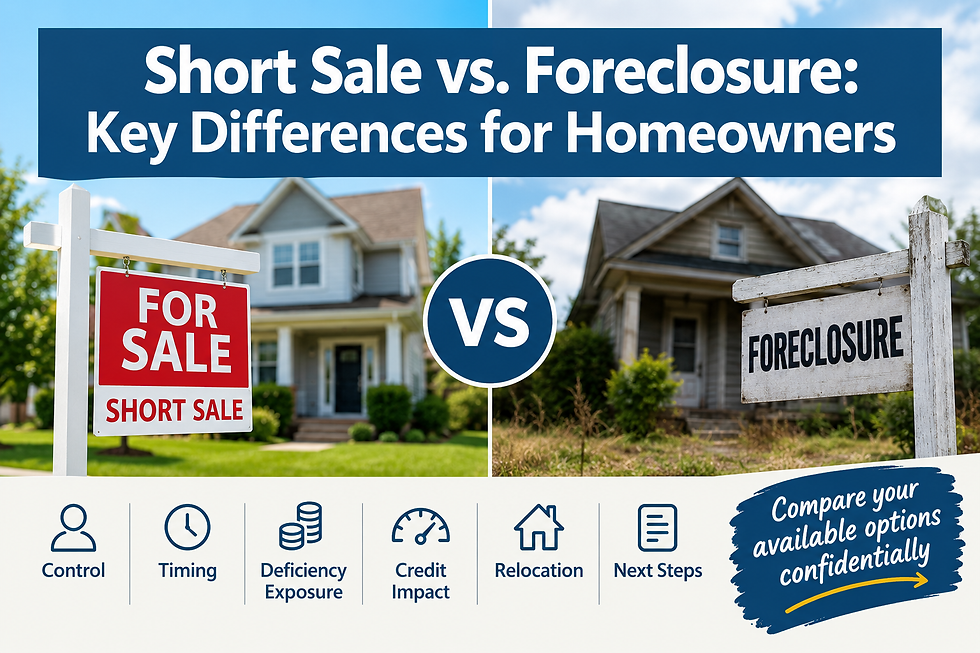
When homeowners are struggling to keep up with mortgage payments, understanding short sale vs foreclosure can help clarify the choices ahead. A short sale may be preferable to foreclosure in some situations, but it is not automatically better for every homeowner. A short sale generally gives the homeowner more involvement in selling the property, while foreclosure is a lender-driven process. The differences can also involve timing, potential deficiency liability, credit reporting, relocation, and future housing plans. The right option depends on the homeowner's circumstances, mortgage terms, lender requirements, and applicable law.
What Is the Difference Between a Short Sale and Foreclosure?
A short sale is a type of mortgage loss mitigation in which a home is sold for less than the amount owed on the mortgage, with approval from the mortgage servicer or lender. The homeowner typically works with a real estate professional to market the property and obtain an offer that is then submitted for review.
The Consumer Financial Protection Bureau (CFPB) describes a short sale as an alternative to foreclosure that may allow a homeowner to sell the property even when the sale proceeds are less than the remaining mortgage balance.
Foreclosure, by comparison, is the process through which a lender or authorized party seeks to recover the mortgage debt after default. The property may ultimately be sold or transferred through the foreclosure process.
The key distinction is simple:
Short sale: The homeowner sells the property with required lender approval.
Foreclosure: The lender or authorized party proceeds with the foreclosure process.
Short sale: The homeowner generally has more involvement in the sale.
Foreclosure: The homeowner typically has less control over the disposition of the property.
Neither option should be viewed as an automatic solution. Homeowners should evaluate their circumstances before choosing a path.
Short Sale vs. Foreclosure: How Much Control Does the Homeowner Have?
Control is one of the most noticeable differences between a short sale and foreclosure.
During a short sale, the homeowner generally participates in preparing the property for sale, selecting or working with a real estate professional, reviewing offers, and coordinating the transaction. However, the lender or mortgage servicer still has an important role because the proposed sale generally requires approval.
That means a short sale offers more homeowner involvement, but not complete control.
In a foreclosure, the lender or authorized party controls the foreclosure process. The homeowner may have fewer opportunities to determine how the property is marketed, sold, or transferred.
For someone who wants to actively participate in selling the property and planning a move, this difference may be significant.
How Timing Can Differ Between a Short Sale and Foreclosure
Timing is another important consideration.
A short sale can involve multiple stages, including:
Reviewing the homeowner's financial hardship
Determining the property's market value
Preparing and listing the property
Finding a buyer
Receiving an offer
Preparing the lender's required documentation
Submitting the offer for review
Negotiating or responding to lender requests
Receiving written approval
Completing the closing
The timing can depend on the buyer, lender or servicer, documentation, property condition, title issues, and other transaction details.
Foreclosure follows a different process, with deadlines and procedures that depend on the circumstances and applicable law.
Because timing can affect both options, homeowners should communicate with their mortgage servicer as early as possible. The CFPB recommends contacting the servicer right away when a homeowner is worried about missing a mortgage payment.
Waiting until a foreclosure deadline is close may reduce the amount of time available to evaluate alternatives.
Deficiency Exposure: Could You Still Owe Money?
One of the most important issues in a short sale vs foreclosure comparison is what happens if the property does not generate enough money to cover the mortgage debt.
The difference between the amount owed and the amount recovered may be referred to as a deficiency.
A short sale does not automatically mean that every remaining amount is forgiven. The CFPB advises homeowners to understand whether the lender or servicer will waive a deficiency and to obtain any waiver in writing.
Foreclosure can also involve potential deficiency exposure depending on the loan, circumstances, and applicable law.
This is why homeowners should avoid assuming that a short sale or foreclosure automatically eliminates remaining debt.
Before moving forward with a short sale, carefully review the lender's written approval and understand exactly what it says about the mortgage balance and any remaining obligation.
If you have questions about legal liability, consulting a qualified attorney may be appropriate.
Credit Impact Can Vary With Your Circumstances
Credit impact is often one of the first questions homeowners ask when comparing a short sale and foreclosure.
Both can affect credit.
The impact can depend on factors such as:
Whether mortgage payments were already missed
How the account is reported
The timing of the default
How the transaction is completed
Other information appearing on the credit report
Individual lender underwriting requirements
The Federal Trade Commission notes that short sales, deeds-in-lieu, and foreclosures can affect credit, and that foreclosure may have a greater impact on future access to credit.
This means there is no responsible way to promise a specific credit-score result from choosing a short sale.
Homeowners should consider their complete credit situation rather than focusing only on whether one option sounds better in general.
Relocation May Be Easier to Plan With a Short Sale
Both a short sale and foreclosure can ultimately result in the homeowner leaving the property.
With a short sale, the homeowner is actively selling the home, which may provide more opportunity to coordinate the transaction and relocation.
The CFPB also recommends asking about potential relocation assistance when considering a short sale.
Depending on the program and circumstances, relocation assistance may or may not be available.
With foreclosure, the homeowner generally has less control over the overall process and may have fewer opportunities to coordinate the transition according to personal preferences.
When comparing the two options, consider:
Where you will live next
Expected moving expenses
Housing costs after leaving
How much time you need to relocate
Whether relocation assistance may be available
What the lender's written agreement requires
Short Sale vs. Foreclosure: Side-by-Side Comparison
Factor | Short Sale | Foreclosure |
Control | Homeowner generally participates in the sale | Lender or authorized party controls the foreclosure process |
Timing | Depends on marketing, buyer, lender review, and closing | Depends on the applicable foreclosure process |
Lender involvement | Approval generally required | Lender or authorized party initiates/proceeds with foreclosure |
Deficiency | May remain unless properly waived or otherwise resolved | May remain depending on applicable circumstances and law |
Credit | Can affect credit | Can have significant credit consequences |
Relocation | May allow more planning around a sale | Timing may be less flexible |
Future housing | Future qualification depends on individual circumstances | Future qualification may be affected by foreclosure history |
Outcome | Property is sold through an approved transaction | Property proceeds through foreclosure |
What Should Homeowners Do Before Choosing an Option?
The CFPB identifies several possible options for homeowners who are struggling with mortgage payments, including loan modification, repayment plans, forbearance, short sale, and deed-in-lieu of foreclosure.
Before deciding between a short sale and foreclosure, consider these steps.
1. Contact Your Mortgage Servicer
Tell the servicer about your financial hardship and ask what loss-mitigation options may be available.
The sooner you start the conversation, the more opportunity you may have to understand your choices.
2. Determine Your Home's Current Market Value
Understanding what the property could realistically sell for is important.
If the property has enough equity to pay off the mortgage and selling expenses, a traditional sale may be worth evaluating.
If the property's value is below the mortgage balance, a short sale may be one option to discuss with the servicer.
3. Review Your Total Mortgage Debt
Look beyond the first mortgage. Other loans, liens, or obligations secured by the property may affect the transaction.
4. Understand the Written Terms
Never rely solely on verbal assurances.
If a short sale is approved, review the written approval carefully, including provisions regarding the mortgage balance, deficiency, closing requirements, and any relocation assistance.
5. Explore Alternatives
A short sale and foreclosure are not necessarily the only choices.
Depending on your situation, you may be able to explore options such as:
Loan modification
Repayment plan
Forbearance
Traditional sale
Deed-in-lieu of foreclosure
Other loss-mitigation programs
The CFPB recommends contacting the mortgage servicer and a HUD-approved housing counseling agency to understand available options.
6. Be Careful With Foreclosure-Relief Scams
Homeowners facing financial hardship can be targets for scams.
The CFPB warns against companies that guarantee they can prevent foreclosure, promise specific mortgage modifications, request upfront fees, or instruct homeowners to stop communicating with their mortgage company.
If someone is promising a guaranteed outcome, take a step back and verify the information before signing anything.
Is a Short Sale Better Than Foreclosure?
A short sale may be a better option than foreclosure for some homeowners, but there is no universal answer.
A short sale can provide greater involvement in selling the property and may give the homeowner more opportunity to plan the transition. It may also provide an alternative to completing a foreclosure.
However, short sales require lender or servicer approval, can take time, and may involve questions about remaining debt and credit consequences.
Foreclosure may become the path when other solutions are unavailable or unsuccessful, but it can also create significant financial and credit consequences.
The best decision depends on the specific terms available to the homeowner, not simply on which option sounds better.
Frequently Asked Questions About Short Sale vs. Foreclosure
1. Is a short sale better than foreclosure?
It may be better for some homeowners, particularly those who want to participate in selling their property and explore an alternative to foreclosure. However, the financial, credit, deficiency, and relocation consequences should be evaluated individually.
2. Does a short sale eliminate mortgage debt?
Not automatically. The terms of the lender's or servicer's approval determine how the remaining balance is handled. Homeowners should ask whether any deficiency is waived and obtain important agreements in writing.
3. Does foreclosure affect your credit?
Yes. Foreclosure can negatively affect credit and may make obtaining future credit more difficult. The FTC notes that foreclosure can have a greater impact on future credit qualification than some other loss-mitigation alternatives.
4. Can I sell my home before foreclosure?
Potentially. If there is sufficient equity, a traditional sale may be possible. If the home's value is below the mortgage balance, a short sale may be another option to discuss with the servicer.
5. Does a lender have to approve a short sale?
Generally, yes. Because the property is being sold for less than the amount owed, the mortgage servicer or lender must approve the proposed transaction before the short sale can proceed.
6. Can I receive relocation assistance after a short sale?
Potentially. Some programs may provide relocation assistance when eligibility requirements are met. Homeowners should ask their servicer about any assistance available for their particular situation.
7. What should I do if I am worried about foreclosure?
Contact your mortgage servicer as soon as possible and ask about available loss-mitigation options. You can also contact a HUD-approved housing counseling agency for independent guidance. HUD provides a nationwide housing counseling network for homeowners dealing with mortgage delinquency and foreclosure concerns.
Compare Your Options Before Making a Decision
If you're weighing short sale vs foreclosure, the most important step is understanding what each option could mean for your specific situation.
Your home's value, mortgage balance, payment history, lender requirements, potential deficiency, credit circumstances, and relocation needs can all influence the decision.
Compare your available options confidentially before taking the next step.
Getting informed early can give you more time to evaluate alternatives and determine which path may make sense for your circumstances.
This article is for general educational purposes only and is not legal, tax, financial, credit, or mortgage advice. Short-sale and foreclosure outcomes vary based on individual circumstances, loan documents, lender requirements, and applicable law. No particular outcome is guaranteed.
Authoritative Sources
Consumer Financial Protection Bureau — Mortgage payment options and foreclosure assistance
Consumer Financial Protection Bureau — Short sale definition and deficiency considerations
Federal Trade Commission — Trouble Paying Your Mortgage or Facing Foreclosure
U.S. Department of Housing and Urban Development — Housing Counseling
HUD — Home disposition and loss-mitigation options


Comments